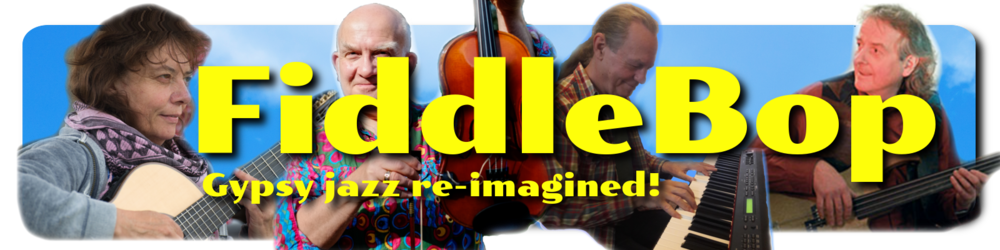
FiddleBop: live audio
All these were recorded live at the Dragon Theatre, Barmouth, on 25 September 2026.
The Abbots Bromley Horn Dance, a rousing traditional tune used in one of England's oldest surviving medieval folk rituals, from Abbots Bromley (duh!) in Staffordshire.
Dinah is a song from 1925, by Harry Akst, Sam M. Lewis, and Joe Young. It was recorded by the Hot Club de France in December 1934.
Bei Mir Bistu Shein is a song that was originally in Yiddish, by Jacob Jacobs and Sholom Secunda. It was written for a 1932 musical which closed after one season. When English words were added by Sammy Cahn in 1937, it became a big hit for the then-unknown Andrews Sisters. The title means “To me, you're beautiful”.
This Scottish traditional song, The Parting Glass, is often sung at the end of a gathering of friends. The "parting glass", or "stirrup cup", was the final hospitality offered to a departing guest. Once they had mounted their horse, they were presented one final drink to fortify them for their travels. The earliest known printed version was as a broadside sheet in the 1770s.
Douce Ambiance was composed by Django Reinhardt in 1943. The title literally means “Sweet Atmosphere”: colloquially, it means "Breath of Fresh Air".
Thirteen-and-a-half Days in the Desert was written by FiddleBop's guitarist/singer, Joanna Davies.
O'Carolan's Concerto is the most famous composition by the blind Irish harper, Turlough O'Carolan (1670–1738).
Cheek to Cheek is by Irving Berlin, who also wrote “White Christmas” and c. 1500 other songs. It was composed in 1935 for the Fred Astaire and Ginger Rogers film "Top Hat". Fred Astaire sings it to Ginger Rogers as they dance.
Limehouse Blues was written in the 1920s by the London-based duo of Douglas Furber and Philip Braham. Limehouse was London’s Chinatown. The song is not a blues, despite the title.
Morrison's Jig is a well-known traditional Irish jig. It is named after the renowned Sligo-born Irish-American fiddler James "The Professor" Morrison (1891–1947).
Still With Me is a beautiful song by FiddleBop's guitarist/singer, Joanna Davies. Jo wrote it for her mother Sonia.
Sweet Georgia Brown is a hit tune from 1925, by Ben Birnie, Maceo Pinkard, and Kenneth Casey. The words (which FiddleBop doesn't sing) were supposedly about the baby daughter of Dr George Thaddeus Brown, member of the State House of Representatives for Georgia, USA. The 1925 recording was the first recorded song to have a saxophone solo in it.
Naima is an beautiful ballad composed by John Coltrane in 1959. It was named after his first wife, Juanita Naima Grubbs. The tune first appeared on the album "Giant Steps".
Give Me Your Hand is a tune from the Irish folk tradition. It is a slow air from about 1603 written by the blind harpist Ruairdi Dáll Ó Catháin (“blind Roger O'Keane”) from Derry. The tune is called “Da Mihi Manum” in Latin, and “Tabhair dom do Lámh” in Irish). Supposedly written following a disagreement with a Lady Eglinton from Scotland, it Was played at the Scottish court of King James the sixth.
Jo's Gypsy Jazz is by Joanna Davies, FiddleBop's guitarist/singer. It is in the Gitane style of Gypsy music, and like many Gypsy tunes, it starts slowly and gets faster.
Sheebeg Sheemore is a tune by blind Irish harper Turlough O'Carolan. In Irish, the title is "Sí Bheag, Sí Mhór". The word sí is the Irish for "fairy mound", and the title refers to two small hills in County Leitrim, which are said to be ancient burial sites.
The song Here, There, and Everywhere is by Paul McCartney, and is on the 1966 Beatles album "Revolver". McCartney includes it among his personal favourites of all the songs he has written. It written by the swimming pool at John Lennon's house in Weybridge. In 2000, Mojo magazine ranked it 4th in their list of the greatest songs of all time.
Black Bottom is the tune for the Black Bottom dance, which became hugely popular during the Flapper Era, the 1920s. However the dance itself dates from the early 1900s in New Orleans, being derived from a low-life dance called the "Jacksonville Rounders' Dance".
The Devil Among the Tailors is a traditional Scottish reel. The "devil among the tailors" is also a form of table skittles which can still sometimes be found as a pub game in England. The "devil" refers to the ball and the "tailors" are the skittles.
Minor Swing is Django Reinhardt's version of a traditional Gypsy tune, composed in 1937. It is probably the most-played tune in the Gypsy swing repertoire. You can hear it in the movie "Chocolat", from 2000, which starred Johnny Depp.
Crazy Rhythm was written in 1928 by Irving Caesar, Joseph Meyer, and Roger Wolfe Kahn, for a Broadway musical. It was often used as the closing music for "The Goon Show".
It Don't Mean a Thing was written by Duke Ellington in 1931, with words by Irving Mills.
Dark Eyes is a Russian tune from the 19th century which has become a Gypsy jazz standard. It was recorded by the Hot Club de France as "Les Yeux Noir" in 1940. "The church is near but the road is icy; the bar is far away but I will walk carefully." (Russian Proverb).

 info@fiddlebop.org
 01982 560726
 Site map
 FiddleBop
 @FiddleBop
 @fiddlebop
 @FiddleBop
 Get our email newsletter